

[News from Members] Sharing knowledge: The Role of Whey in Slurry Management
Austria: Hiasnhof’s experience
For many farmhouse cheesemakers, whey is both a valuable by-product and a practical challenge. Every kilogram of cheese produced generates several litres of whey and finding sustainable ways to use it remains an important topic for cheesemakers across Europe.
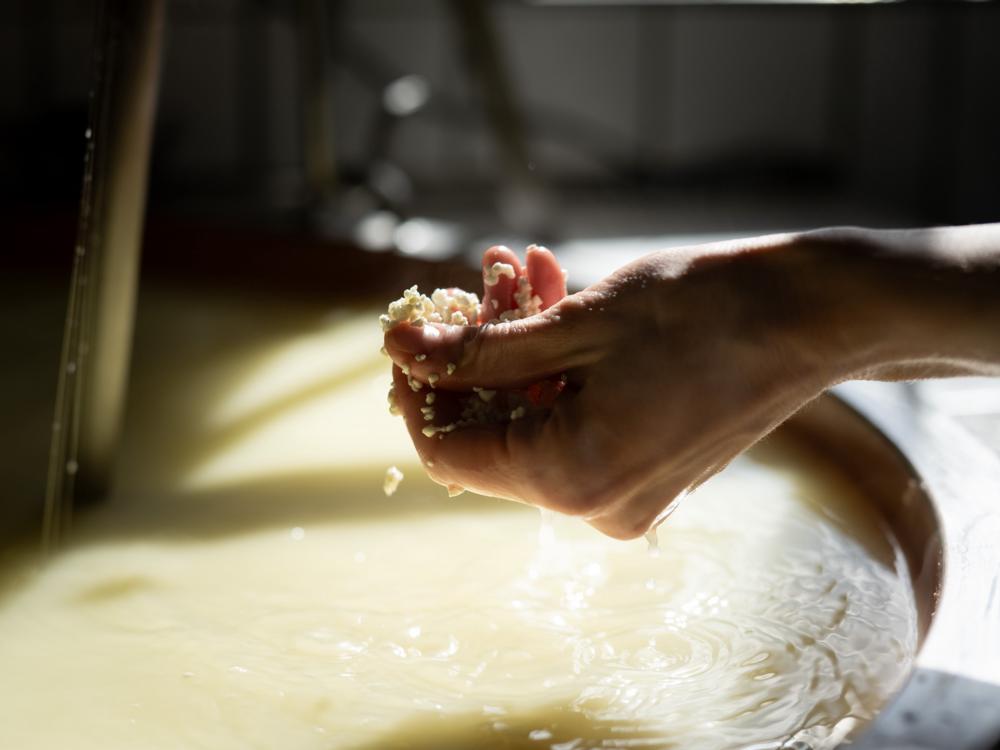
At our farm in Salzburg, Austria, some of the whey is processed into ricotta. However, ricotta is not part of Austrian traditional cuisine and therefore demand is limited. As a result, we cannot utilise all the approximately 45000 litres of whey produced annually in this way. Thus, the remaining whey is added to our cattle slurry.
This raises an interesting question: how does whey affect slurry during storage and can it improve the fertilising value of the liquid manure applied to our grassland?
The most important effect of whey is its ability to lower slurry pH.
Whey contains lactic acid, which acidifies the slurry. The relationship between pH and nitrogen losses is well known: at higher pH values, more nitrogen is converted into ammonia gas (NH₃) and escapes into the atmosphere. At lower pH values, nitrogen remains predominantly in the form of ammonium (NH₄⁺), which stays dissolved in the slurry and is available for crop uptake and growth.
For this reason, a manure slurry pH below 7 is considered beneficial. On our farm, the slurry mixed with whey consistently remains below pH 7, therefore contributing to improved nutrient efficiency while simultaneously reducing environmental emissions.
However, the studies available on this topic investigated a 1:1 mixture of whey and slurry.
In our case, the amount of whey available is much lower relative to the slurry volume. We currently produce around 45 m³ of whey and approximately 500 m³ of liquid manure annually. Despite this much lower mixing ratio, the pH of our slurry consistently remains below 7.
This suggests that, at least under our farm conditions, a 1:1 mixture may not be necessary to achieve the desired acidifying effect. This observation is based solely on measurements from our farm, as no comparison with slurry from other farms was carried out.
Furthermore, improvements in grassland production related to nutrients contained in whey itself can be observed.
Research has shown higher dry matter yields where whey-slurry mixtures were applied compared with slurry diluted with water. These results are likely the consequence of two factors: the nutrients supplied directly by the whey and the improved preservation of nitrogen resulting from the lower slurry pH.
Odour development is sometimes mentioned as a potential disadvantage of storing whey together with manure slurry. While some research reports stronger odours during prolonged storage, we have not observed any noticeable increase, even when the mixture is stored throughout the winter months.

For our farm, the co-storage of whey and manure slurry has become a valuable tool for improving slurry management. Whey is a resource that helps keep valuable nutrients on the farm, in the soil and available for plant growth.