
[Sharing Knowledge] Yeasts aren’t only there for the bubbles
Kefir vs. Yogurt and Cheese
The following article, published on the website www.milkandhealth.com , explores what sets kefir apart from other fermented dairy products such as yogurt and cheese. Written by Ton Baars (Netherlands), it examines the roles of mesophilic versus thermophilic bacterial cultures, the distinctive contribution of yeasts to kefir’s fermentation process and the effect of these differences on vitamin K2 content.
In this article, we have summarised the key aspects of the debate: raw versus pasteurised, mesophilic versus thermophilic fermentation, and the use or non-use of yeasts. Naturally, this is supported by the most recent literature.
Spot the differences
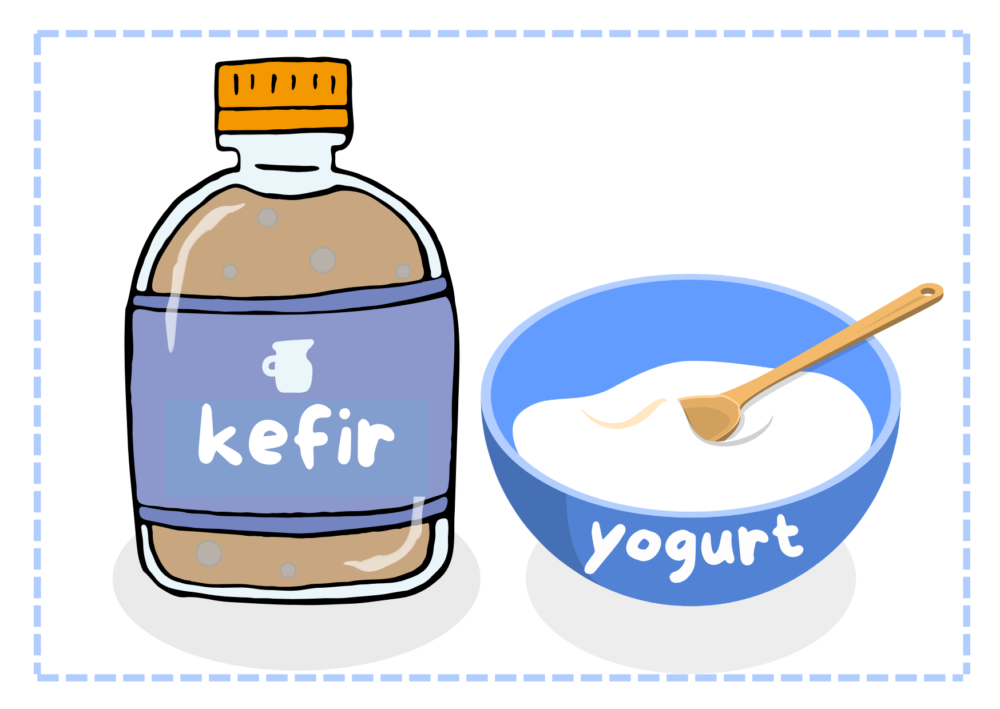
‘Real’ kefir contains both lactic acid bacteria and yeasts. Kefir differs fundamentally from yoghurt in two respects. Firstly, the bacterial starter culture in yoghurt is thermophilic, whilst that in kefir is mesophilic. Secondly, kefir contains yeasts, which cause a second fermentation: the breakdown of the lactic acid formed by the bacteria into carbon dioxide and by-products. Yoghurt must be free from yeasts. There may also be a third difference, namely heating. Kefir is also available as raw-milk kefir rather than kefir made from heated milk, and this has the advantage that the protective properties of raw milk (against allergies) are partially retained, as the whey proteins remain intact.
Mesophilic versus thermophilic: vitamin K2
Gouda, Cheddar, quark and kefir are made at low temperatures. Kefir is made at 24–28 °C, as is quark, whilst Gouda is made at a temperature no higher than body temperature. Mesophilic lactic acid bacteria are used for this. In contrast, there are mountain cheeses, such as Emmental, Gruyère and the very large Parmesan cheeses, as well as fresh cheeses like Mozzarella, which are made at much higher temperatures, namely between 50–58 °C. In German, this is referred to as ‘brennen’ (burning) the cheese curd. This requires different types of bacteria, known as thermophilic lactic acid bacteria. The same applies to yoghurt, which is made after the milk has been boiled above 90 °C before inoculation at 42–45 °C.
We have previously written about the formation of vitamin K2 during lactic acid fermentation. There is a key difference in the amount of K2 between mesophilic and thermophilic cultures. Yoghurt (thermophilic) contains virtually no K2, whilst quark (mesophilic) has very high K2 levels. The same trend can be seen between Gouda (mesophilic) and mountain cheeses (thermophilic).
There is a taboo surrounding raw milk. Governments and the industry do not want it. Too scary, too threatening. That is why we have also highlighted the other side of raw milk, namely the question of how farmers can mitigate the risks associated with it. Life is not without risks; we realise that too, but if you face up to the risks and know how to deal with them, we see more benefits in raw milk than risks.
Research into raw milk kefir is now also underway. Strangely enough, the discussion about risks is virtually absent here. The rapid fermentation of fresh, raw milk produces a stable and reliable dairy product that has a shelf life of several weeks.