
[Events]: Science of Artisan Cheese Conference in UK
Insights and Experiences from the 8th Science of Artisan Cheese Conference
by Szabolcs Elek – Hungary
August 18–19, 2026, North Cadbury Court, Somerset
Two days when the world revolves almost entirely around cheese. Cheesemakers, scientists, researchers, traders, and cheesemongers gather in one room to discuss everything from the latest microbiological findings to old economic records—anything that might help us better understand cheese. Along the way, they taste, debate, build relationships, and at times come very close to what I can only describe as the spiritual side of cheesemaking.
This is the Science of Artisan Cheese, whose first conference was held in 2012 and which has since brought together the international community of the trade every two years. The eighth conference was held on August 18–19, 2026, at North Cadbury Court in Somerset. The history of the conference and this year’s event
It was an honor for me to attend this event for the second time, with the support of the Hungarian Cheese Makers’ Association. Participating also meant working hard:
I wanted to bring home as much knowledge as possible, build connections, and talk with speakers and experts who could help advance Hungarian cheese culture in the future. Achieving all of this in just two days proved to be a rather ambitious undertaking.
Polly Russell, a staff member at the British Library, demonstrated right from the opening lecture just how many different sources the knowledge needed for cheese-making can come from. She spoke about archives: how old recipes, techniques, and culinary customs are preserved, and what gets lost in the process. I was particularly struck by the fact that the knowledge we seek is often hidden in diaries, farm records, handwritten notes, or memoirs. A few sentences from a rural person can preserve an entire technological mindset.
A good example of this is the revival of traditional Wensleydale. Old descriptions and recipes helped farms—including that of Andrew and Sally Hattan—begin making the cheese again in its former, wetter, richer form. According to a report by Courtyard Dairy, Andy Swinscoe also shared a recipe from a 1930s agricultural publication with the producers. From this same historical starting point, different cheeses eventually emerged: each bore the distinctive characteristics of its own farm.
The Story of the Revival of Wensleydale
As I listened to this, I thought about how much similar knowledge might still be waiting to be discovered here as well—in old notebooks, family heirlooms, and in the minds and hands of people we could still ask. The Food Stories audio recordings from the British Library’s collection offer a good taste of how personal stories can become part of our culinary memory.
Benjamin Wolfe, a researcher at Tufts University, revealed this same living, ever-changing world on an entirely different scale. For me, his presentation offered the deepest dive into the lives of molds and yeasts. These tiny organisms seek food, compete, and cooperate, all while shaping the cheese’s environment, flavor, and appearance.
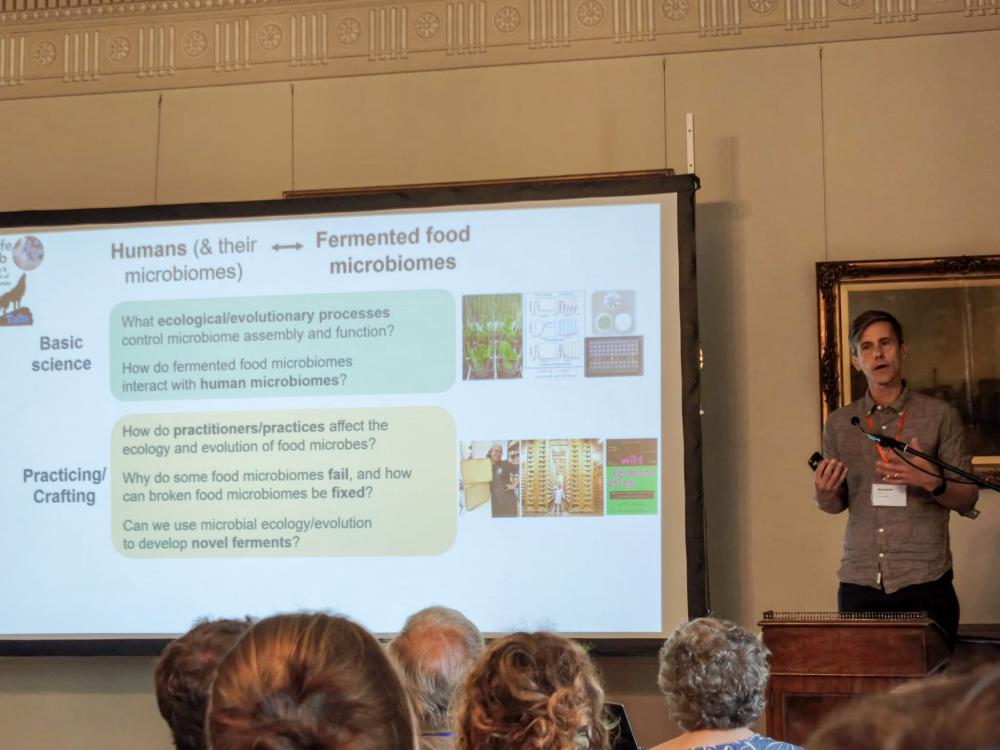
One of the most memorable stories was about the mold living on the surface of Bayley Hazen Blue cheese, aged in the Jasper Hill aging cellars. The previously greenish coating had turned white over the course of a few years. Fortunately, Wolfe’s lab still had samples from 2016, so it was possible to compare the old and new versions. The researchers identified genetic changes affecting pigment production in Penicillium solitum. In the dark aging cellar, producing the pigment that provided protection against light offered less of an advantage, and under these conditions, the white variants gained a competitive edge. Evolution observable in a cheese cellar over the course of a few years: it’s hard to explain more vividly just how much of a living system we’re working with. Tufts University’s report on the research
Equally exciting were the “highways” forming along the fungal filaments, along which certain bacteria can travel more easily across the surface of the cheese. In other interactions, substances produced by the fungi either help or hinder the microbes living around them. Life within the cheese rind is thus much more dynamic than what we see from the outside. Research on the role of fungal filaments
As a cheesemaker, what this means to me is that with every intervention we make, we are shaping the living conditions of an entire community. Temperature, humidity, and even the presence of light raise new questions. The more we learn about this world, the more fascinating the aging process becomes.
Sabrina Longley, a researcher at Nettlebed Creamery and the University of Reading, investigated what happens to cheese and its microbial heritage during digestion. Using the gut model presented in the lecture, they studied the effect of cheese consumption on the gut’s microbial communities, focusing, among other things, on bifidobacteria and members of the Lactococcus group.
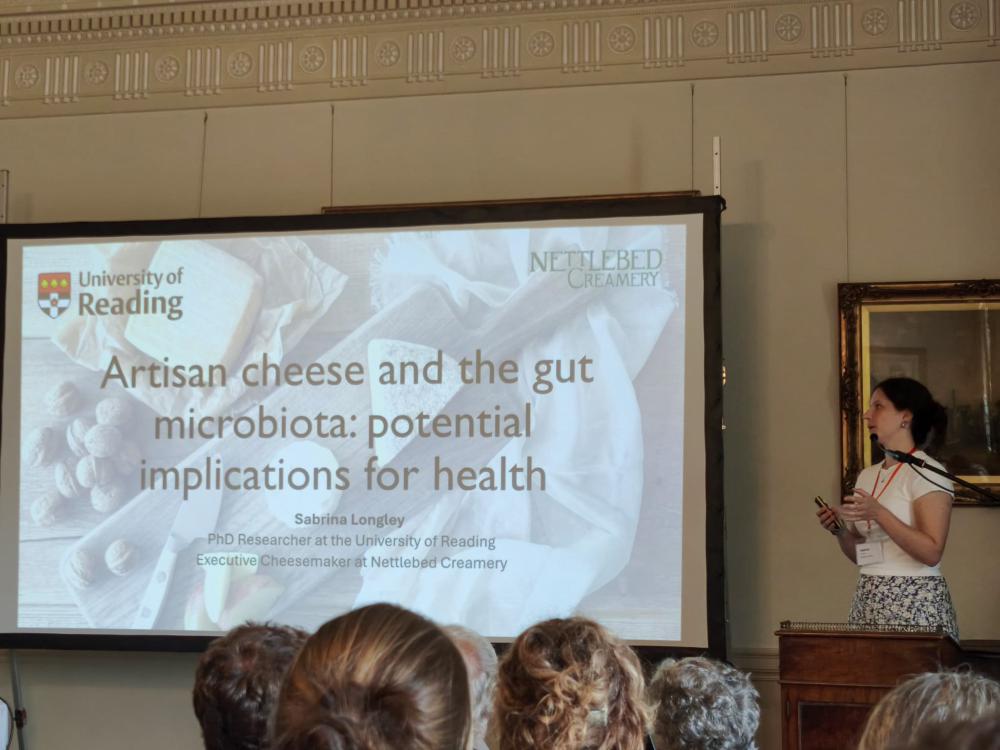
I was particularly struck by the findings related to hay-aged cheese. It is an intriguing question how this unique aging environment might contribute to the cheese’s microbiological and biochemical properties. However, the exact role of hay requires further investigation. The changes observed in the laboratory gut model do not automatically imply proven health or probiotic effects in humans; therefore, the University of Reading’s research program also included a study involving human participants. University of Reading overview
Giles Yeo’s presentation, titled “The Role of Cheese in the Post-Ozempic World,” also addressed issues of health and nutrition. By the end of the day, as a cheese lover, it would, of course, have been easy to take home a few overly enthusiastic takeaways: more full-fat cheese, fewer worries—just don’t let my doctor hear that.
The scientific takeaway is more nuanced than that, but still interesting. The structure of cheese—the fat, protein, and calcium present together—can influence how the body reacts to it. In a controlled study, for example, blood lipid levels differed depending on whether participants consumed the same ingredients as cheese or in their separate forms. This helps us think more precisely about cheese, but on its own, it does not support claims that cheese causes or treats high cholesterol. A study examining the effects of cheese structure
One of the highlights of the conference was when we could taste the theory firsthand.
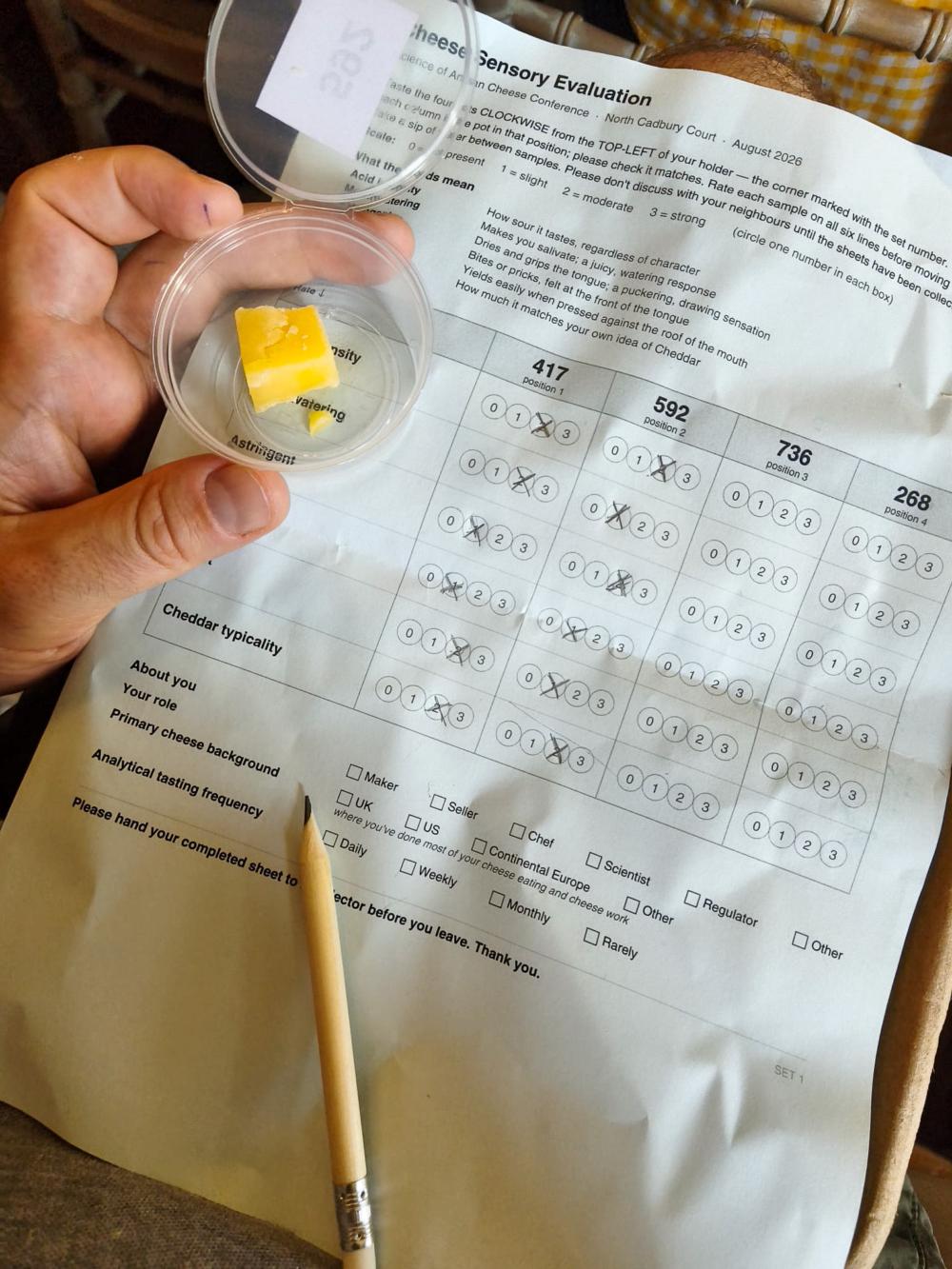
Eight British producers participated in Westcombe Dairy’s collaborative cheddar experiment, and the cheeses presented allowed for a comparison of the results of four different cheddar-making processes.
Each cheese exhibited the characteristic cheddar flavor, yet there were noticeable differences between them. For me, the differences in one or two samples were quite significant. The variations in moisture, acidity, and saltiness became particularly clear when we tasted the cheeses side by side. Such a comparison really highlights just how significant the decisions made during production can be.
Yet listening to the participating cheesemakers was just as memorable. As they spoke about their collaborative work, their experiences, and each other’s approaches, it was clear just how much the collaboration itself had given them. It would be wonderful to recreate this experience as often as possible back home.
Ivan Larcher’s hands-on workshops offered several insights that I’d love to write right away on the wall of a cheese workshop. One of the most powerful: we should assess and thoroughly examine our cheese when it turns out well. That way, we’ll have a baseline to compare against if deviations occur later.
In his presentation on discoloration, he also discussed the pinkish and brownish changes that occur in blue cheeses. From the detailed biochemical explanation, what stood out to me most was the importance of prevention. By the time an anomaly becomes clearly visible, the underlying process may already be well underway. This is why consistent observation, measuring ripening conditions, and recording data are so important: they can help us recognize in time that something is happening differently than usual.
The presentations on biogenic amines were also related to this topic. Igor Baroja and Stefan Irmler demonstrated how the presence of certain microbes can be linked to undesirable compounds and quality defects in cheese. Certain strains of Latilactobacillus curvatus, for example, can produce biogenic amines. In sufficiently large quantities, these compounds can cause illness, depending on individual sensitivity. The key takeaway here, too, was understanding the process and identifying the source of the problem.
Agroscope’s research, background on biogenic amines
Food safety was a prominent theme throughout the program. Discussions covered Shiga toxin-producing E. coli bacteria, new prevention strategies, the detection of bovine tuberculosis, and vaccine trials. Other presentations explored issues related to animal welfare, sustainable dairy production, and the collective efforts of French raw-milk cheese makers. All of this clearly demonstrated the breadth of background knowledge required for the work of a small-scale cheese maker. The full conference program
Another presentation by Ivan Larcher—one that was particularly important to me—focused on the healthy rind of soft cheeses. Right from the start, he caught my attention by explaining that, under the right conditions and with careful management, it is possible to age different types of cheese together in the same ripening chamber.
The presentation made it clear just how important it is to understand which microorganisms to encourage, when, and under what conditions.
The sequence of events in rind development is also significant. Geotrichum, white molds, and other microbes can play different roles during the various stages of ripening. The cheesemaker uses moisture, salting, temperature, and humidity to determine which of these comes to the fore and when.
Larcher made no secret of his own taste: he easily finds cheese that is overly stabilized and remains unchanged for a long time to be boring. As a small-scale producer, he believes it’s worth consciously seeking out individual character. One idea that particularly stuck with me was that what we consider a flaw in one cheese might actually be a desirable trait in another. To achieve this, however, we need to know exactly what kind of cheese we want to make and how to get there.
Jemima Hodgson, the cheesemaker at Old Kate’s Farm, added a very personal perspective to this awareness. She spoke about time, acidification, the culture maintained from her own milk, and daily observation. She spoke of the attention with which she repeatedly examines, tastes, and interprets what is happening with the milk and the curd.
This is where the concept of embodied knowledge came up—knowledge that lives in the body and in practice. It is the experience present in the maker’s hands, senses, and timing. When she recognizes the state of the curd, feels the speed of the process, and knows that now is the time to move forward.
Her presentation also addressed faith and the connection to animals and milk. It was interesting, moving, and, for me, at times unusual to hear this at a scientific conference. Yet she described a familiar experience: when we become so immersed in our work that time ceases to exist around us, and for a while, there really is nothing but the cheese.
Of course, two days like this come at a price. Among the veteran cheesemakers sitting on the sofas in the front rows, someone would sometimes doze off by the afternoon, only to return to the world of microbiology after a gentle nudge from their neighbor. I’ll admit, I completely understood them.
This year, instead of a video recording, we made an audio recording, so I tried to take photos of as many slides as possible while taking notes, paying attention, and chatting during the breaks.
By evening, my brain was full. After 8 p.m., a single glass of beer was more than enough to make me drowsy, and after a while, I couldn’t really form sentences in either English or Hungarian.
And yet, in addition to the presentations, I had three missions with me. The first was to build useful connections for the association. In the second, I took on the role of the FACE Network’s undercover ninja: I tried to convince my British colleagues to return to the European cheese-making community, because the European family is waiting for them. Our enthusiasm wasn’t quite on the same level at first, but I hope that through my conversations with the president of the Specialist Cheesemakers Association, we managed to bridge the gap a little. My persistence likely played a role in this as well.
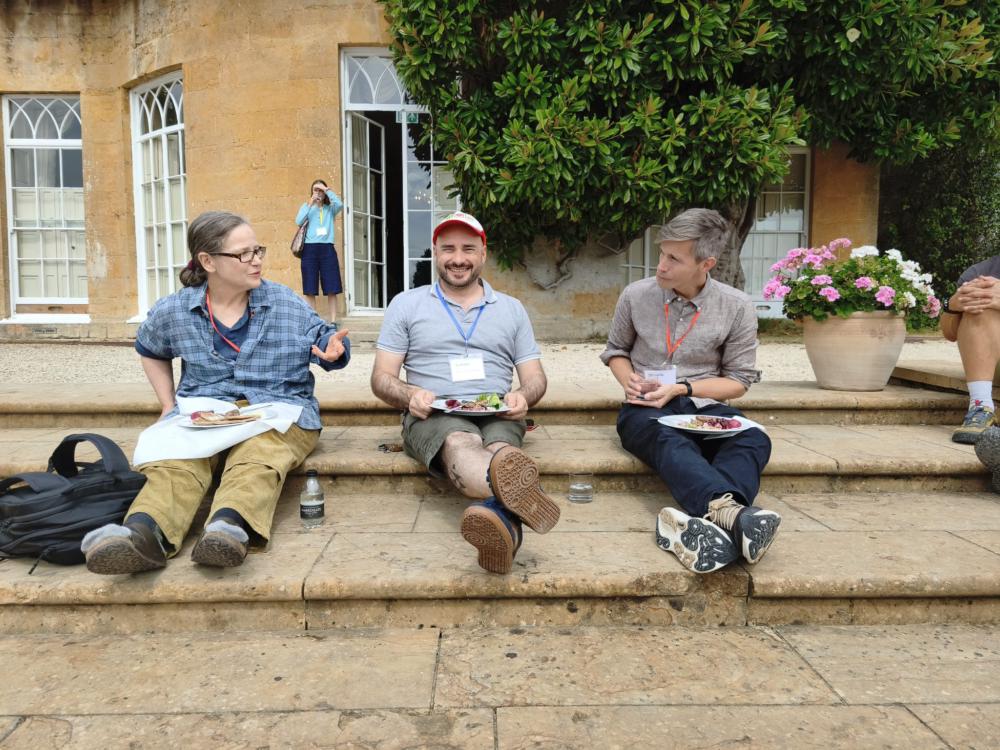
My third important goal was to speak with the current head of Neal’s Yard Dairy. In addition to him, I met numerous other people whose knowledge and experience I would love to see in Hungary as well. I am confident that, over time, these meetings will lead to invitations, shared learning, and professional collaborations.